Social masking — the fatigue we don't see (and that eventually breaks everything)
Social masking (performing neurotypicality) exhausts deeply. Understanding the cumulative cost, post-party decompression, choosing your real unmasked spaces rather than avoiding in silence.
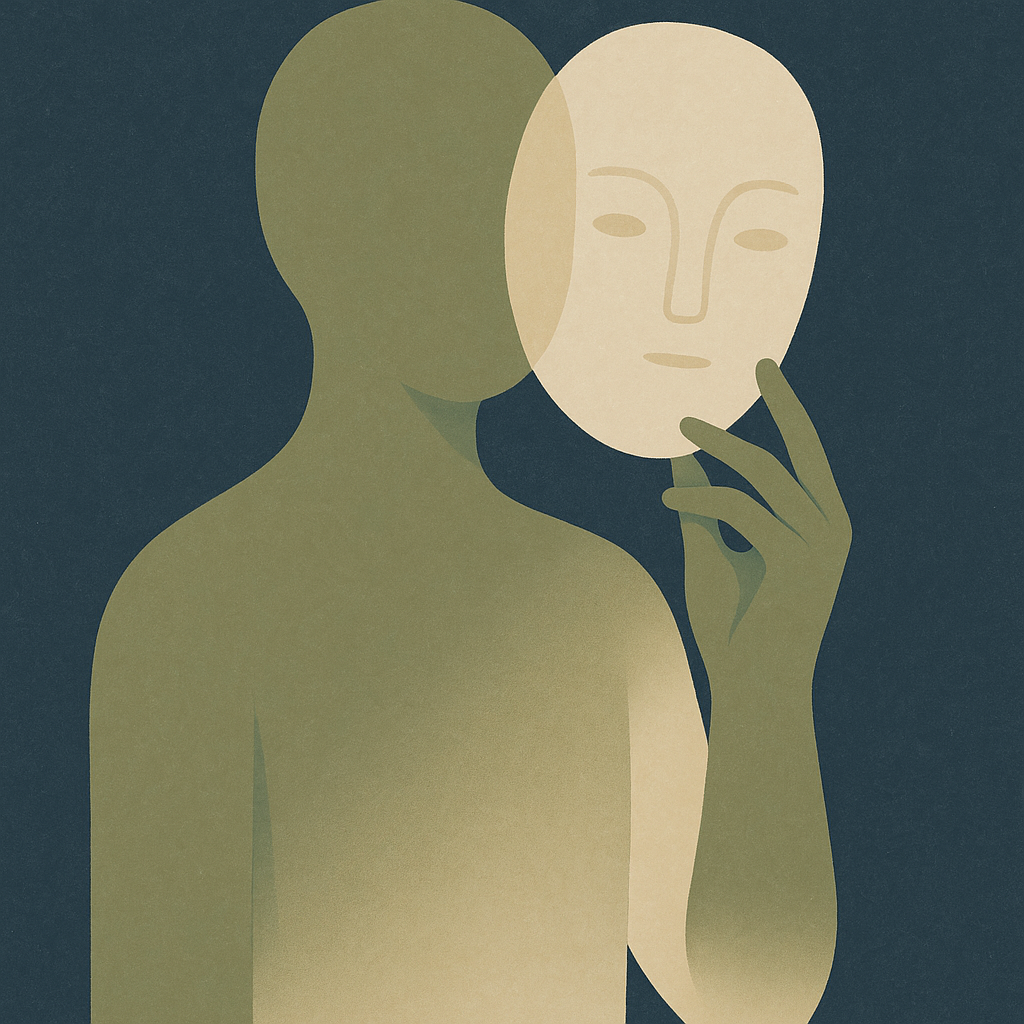
What we’re talking about
Masking (social camouflage): the set of conscious and unconscious strategies we put in place to appear neurotypical in society. Suppressing tics, holding a linear conversation, modulating your voice, containing interruption, forcing eye contact, hiding hypersensitivities, smiling when overwhelmed.
The concept was first studied in autistic adults [1] [2] , then extended to ADHD and AuDHD adults. Researchers like Hull, Pearson, Rose have shown that masking is one of the major factors of psychic distress in adulthood among neurodivergent people.
What masking really costs you
Masking isn’t “being careful in society”. It’s intense cognitive and emotional work, sustained for hours, to perform a non-authentic version of yourself.
What masking mobilises during an evening:
Loads cumulated simultaneously
- Divided attention: listening + analysing tone + monitoring your body language + checking impact.
- Inhibition: not cutting in, not going off on a tangent, not showing boredom.
- Social scripts: replaying in real time what a neurotypical person would say.
- Sensory regulation: ignoring noise, light, smells that overwhelm you.
- Emotional regulation: hiding RSD when it hits, smiling through inner crisis.
- Suppression of stims (self-regulating movements): no bouncing leg, no scratching, no repeated words.
All that for 3 to 5 hours, often without a break. The “I’m just tired” after a mundane evening isn’t mundane — it’s the cumulative load releasing all at once.
People say I’m sociable. What they don’t see is that I take 2 days off after every dinner. I go straight to bed when I get home, I sometimes cry in the shower, and the next day I’m in zombie mode. It’s not the evening that exhausts me, it’s having been someone else for 4 hours.
Why we mask (and why it’s hard to stop)
Qualitative studies [2] [1] identify four main drivers:
1. Protection from rejection
We’ve learned to mask because every time we were authentically ourselves, we were mocked, isolated, criticised. Masking is a social survival strategy, not a pose.
2. Career and financial stability
In professional settings, appearing “normal” is often profitable (promotion, contract, network). Masking has tangible short-term benefits that can’t be waved away.
3. Fear of hurting or disappointing
Many ADHD/AuDHD adults mask to protect their loved ones — not to worry them, not to burden them, not to impose their difference.
4. Merged identity
From masking for 20-30 years, we no longer know who we are without the mask. Removing the mask is scary because we don’t know the person behind it.
Signs your masking is too intense
Overload signals
- You have no energy after work, even if you 'did nothing' physical.
- You cancel all evenings because you're exhausted — not because you don't like people.
- You feel a clear 'before / after' between your public self and your alone self — like two people.
- You cry coming home from evenings that 'went well'.
- You no longer know what you really like (music, clothes, hobbies — you adopted perceived tastes).
- Your health fails in places (immunity, chronic pain, burnout, depression).
- Your relationships are numerous but none are deep — masking prevents intimacy.
Research confirms [2] [4] that prolonged masking is a major risk factor for burnout, depression, and in some studies paradoxical social anxiety (the more you mask, the more you fear the next situation).
Post-party decompression
Essential. Not a “luxury”. Maintenance.
Decompression protocol
- On returningSensory cutoff
Lower all the lights. Take off the 'going out' clothes. Silence or soft music. Don't check messages right away.
- First 30 minutesPhysical discharge
Stims released (moving, vocalising, pacing), weighted blanket, hot shower, simple food. Nobody to talk to.
- Next hourTransition to calm
Low-stimulation activity: reading, repetitive game, series you know by heart. No scrolling (reactivates social mental load).
- Next dayOff or light day
Plan an empty or minimal next day. No sensitive appointments. No important decisions. Hydration, gentle walk, long sleep.
Avoid vs choose — the real question
Many neurodivergent adults end up avoiding all socialising so they don’t have to mask anymore. Result: isolation, loneliness, degraded mental health, rupture with support networks.
Avoiding isn’t the solution. Choosing is the solution.
'Choose your spaces' strategy
- Identify 1-3 people or contexts where you can 'be yourself' (neurodivergent peers, safe family, specific community).
- Invest in these relationships — even if they're fewer than your masking relationships.
- Reduce masking, don't eliminate — start with 10% in moderately safe spaces.
- Tell 1-2 close friends 'I'm ADHD/AuDHD' — often reveals more space than you think.
- Seek neurodivergent spaces (associations, local groups, Discord, forums).
The day I met another AuDHD person, I understood what it was to not translate. We talk in zigzags, we stim, we laugh too loud, we change topics every 3 minutes, and no one finds it weird. I cried going home that night. Not from tiredness. From relief.
Micro-techniques to mask less
You can’t remove the mask everywhere, all the time. But you can remove it in touches in spaces that support it.
Small steps to unmask progressively
Identified ‘safe’ spaces:
- Tell a very close friend: “I’m going to come but I’ll be less on tonight, it’s not you”.
- Don’t force eye contact in intimate dinners.
- Allow yourself to stim discreetly (moving foot, hand playing with an object).
- Wear clothes that are sensorially comfortable for you, not expected ones.
- Leave earlier without justifying in 3 paragraphs (“I’m tired, I’m off, thanks”).
‘Moderately safe’ spaces (colleagues, less close friends):
- Shorten the masking to essentials (active listening, politeness), drop the rest (energy, constant smile).
- Grant yourself a 5-min bathroom break in the middle of a long meal.
- Refuse a 2nd evening in the week without guilt.
- Accept silences in conversation without filling them.
‘Less safe’ spaces (formal professional, complicated family):
- Keep active masking, but reduce time spent.
- Plan decompression before and after, systematically.
- Don’t seek to reveal your neurodivergence without clear benefit.
The question of the neurodivergent coming-out
Should you tell your friends, family, colleagues you’re ADHD / AuDHD? No universal answer. Some reference points:
Reference points for deciding
- Revealing to very close friends: often liberating, allows progressive lowering of the mask.
- Revealing at work: beneficial if formal accommodations are possible, to weigh otherwise (persistent stigmatisation).
- Revealing to family: variable — some families are ready, others aren't. Test on one member first.
- Wait until you have a diagnosis: if significant doubt, setbacks may come. A diagnosis gives more solidity.
- Don't reveal in crisis — make this decision calmly, not in storm mode.
For AuDHD folks — double masking
If you’re AuDHD, your masking combines autistic strategies (social scripts, stim suppression, imitation) AND ADHD strategies (hiding impulsivity, forcing attention, containing disinhibition). That’s double the cognitive work.
Studies on autistic masking [1] [2] are largely applicable — with ADHD amplification.
What remains to be validated
- No validated meta-analysis specific to ADHD masking (vs well-studied autistic masking).
- Fuzziness on neurobiological mechanisms of masking’s cognitive cost.
- Lack of evaluated therapeutic protocols for “unmasking” without relational rupture.
- Cultural differences under-studied.
Research is more advanced on autistic masking than on specific ADHD masking. Worth keeping this modesty.
Moi aussi — raconter çaGo further
Sources citées
Chaque source est classée par niveau de preuve. Clique pour lire l'original.
- [1]Clinique2017'Putting on My Best Normal': Social Camouflaging in Adults with Autism Spectrum Conditions — Hull L, Petrides KV, Allison C, Smith P, Baron-Cohen S, et al.
Foundational qualitative study on camouflaging in autistic adults. Parallels with AuDHD and ADHD.
↑ retour au texte - [2]Clinique2021A conceptual analysis of autistic masking: Understanding the narrative of stigma and the illusion of choice — Pearson A, Rose K
Conceptual analysis of autistic masking. Useful framework for AuDHD.
↑ retour au texte - [3]Clinique2020Emotion dysregulation in adults with attention deficit hyperactivity disorder: a meta-analysis — Beheshti A, Chavanon ML, Christiansen H↑ retour au texte
- [4]Clinique2020Having All of Your Internal Resources Exhausted Beyond Measure — autistic burnout — Raymaker DM, et al.↑ retour au texte
- [5]Praticien2023Unmasking ADHD: Why We Hide, and How to Stop — ADDitude Magazine↑ retour au texte
- [6]Patient2024r/AuDHDWomen — masking fatigue threads (public discussions, variable permalink) — Reddit r/AuDHDWomen
Verbatims used with permalink when available. No integral republication.
↑ retour au texte