Sensory needs and AuDHD — the internal conflict between under-stim and over-stim
The ADHD brain seeks stimulation to get moving. The autistic system is often saturated by ambient input. AuDHD people live both logics at once. Here is what the research says about sensory profiles, stimming, and the accommodations that actually work.
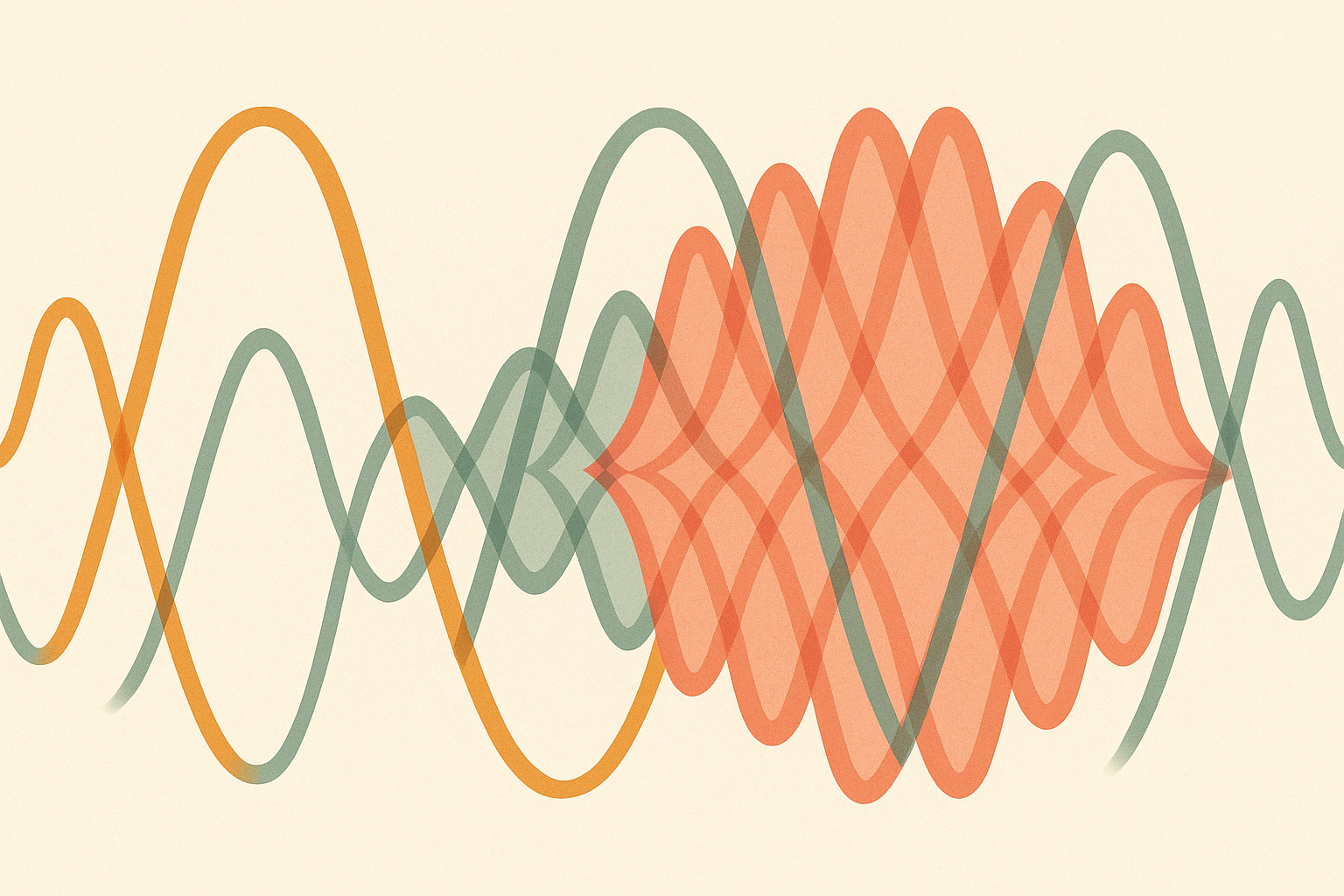
The baseline paradox: seeking AND fleeing stimuli, at the same time
ADHD is often framed as “need for stimulation” and autism as “sensory saturation”. Both are true — they are solid clinical descriptions. The problem is that in AuDHD people, both coexist inside the same nervous system.
Concretely: your ADHD brain needs music, movement, several open tabs to get moving. Your autistic sensory system, meanwhile, may already be saturated by the ceiling light, the fridge humming, the label in your t-shirt. You need cognitive stimulation AND you are already in sensory overload — simultaneously.
This tension is not a whim. It is a documented neurofunctional conflict [9] , and it explains why many AuDHD people describe themselves as “uncomfortable everywhere”: too quiet = unbearable boredom, too stimulating = sensory overload.
Dunn’s model: four quadrants to map it
Winnie Dunn (occupational therapist) proposed a model back in 1997 that remains the clinical reference [2] . It crosses two axes:
- Neurological threshold: high (it takes a lot for the stimulus to register) or low (the slightest stimulus registers).
- Response strategy: passive (endures) or active (tries to change the environment).
That gives four profiles:
| Quadrant | Threshold | Strategy | Typical experience |
|---|---|---|---|
| Low registration | High | Passive | You miss stimuli others catch (you don’t hear someone talking to you, you don’t feel hunger). |
| Sensation seeking | High | Active | You actively add stimuli: loud music, spices, movement, intense tastes. |
| Sensory sensitivity | Low | Passive | You’re distracted or irritated by stimuli but endure them. |
| Sensation avoiding | Low | Active | You flee stimuli: leave a room, cover your ears, avoid rough fabrics. |
What the 2025 meta-analysis says
The large Bijlenga et al. meta-analysis published in JAACAP in 2025 [1] aggregated 30 studies, more than 5,000 participants. Findings:
- People with ADHD show sensory atypicalities significantly more pronounced than controls across four domains: sensory sensitivity, sensory avoiding, low registration, sensation seeking [1] .
- Odds ratio hypersensitivity = 9.0 (95% CI [2.92; 27.71]) in children and adults with ADHD.
- Odds ratio hyposensitivity = 9.71 (95% CI [2.80; 33.61]) in people with ADHD.
- In adults with ADHD, sensory over-responsivity dominates (in other words: the “ADHD adult seeking stim” is often in fact an ADHD adult suffering from stim).
In other words: ADHD is not only “sensation seeking”. It is also, often, a heightened sensory sensitivity — something French clinical practice still largely underestimates [5] .
In AuDHD children specifically, the combination ASD + ADHD produces sensory profiles more atypical than each disorder alone [4] [3] . The Jung et al. (2023) study [3] shows that these atypicalities (auditory filtering, tactile sensitivity, sensation seeking) correlate with emotional and behavioural difficulties.
The sensory axes, in detail
Hearing
- Faulty auditory filtering (you don’t separate your colleague’s voice from the hallway noise).
- Pain from certain high-pitched or loud sounds.
- Simultaneous need for music to concentrate (ADHD component).
Accommodations: Loop or Calmer-type earplugs, ANC headphones, well-designed environments (open-plan office = classic AuDHD trap).
Vision
- Discomfort with fluorescent lights, cold white light, poorly calibrated screens.
- Over-stimulation in visually crowded environments (supermarket, open-plan office).
- Need for visual movement (ADHD component): tabs, videos, scrolling.
Accommodations: warm light, f.lux/night mode, less cluttered desks, a cap outdoors.
Touch
- Labels, seams, synthetic fabrics: discomfort or pain.
- Poor temperature regulation (too hot, too cold).
- Simultaneous need for pressure (weighted blanket, compression clothing).
Accommodations: flat seams, natural fibres, weighted blankets, test before buying.
Interoception (internal body signals)
This is the classic blind spot. AuDHD people often have atypical interoception [9] : hunger, thirst, fatigue, the need to urinate, pain — signals are either missed or arrive late and at high intensity. The result: you skip meals without noticing, you get dehydrated, you discover a pain when it is already severe, you explode emotionally with no intermediate warning.
Accommodations: alarms, scheduled hydration, regular body scan.
Taste and smell
- Powerful aversions to certain textures or smells.
- Need for intensity (spice, acidity) for food to feel satisfying (ADHD component).
- Recurring “safe foods”: not a whim, a regulation strategy.
I turn the music up loud because my brain is craving signal, and I end up in shutdown in the dark because it saturated everything.
Stimming: a tool, not a tic
Stimming (self-stimulatory behavior) covers the repetitive behaviours that help regulate sensory or emotional activation: rocking, tapping, fidgeting with an object, humming, bouncing a leg, turning a ring, scratching a texture.
The research is clear: stimming is not a symptom to suppress [6] [7] . It is a regulation strategy — sensory, emotional, cognitive.
- In autistic people: stimming mainly serves emotional and sensory regulation (blocking an unpredictable stimulus, soothing intensity) [6] .
- In ADHD people: stimming mainly serves arousal/attention maintenance (moving to stay focused) [8] .
- In AuDHD: both logics alternate or overlap. You stim to stay awake and you stim to protect yourself from overload — sometimes within the same hour.
The “stimming suppression” approach (long standard in ABA) is now criticised [6] . The conversation has moved to safe and socially acceptable stimming, not extinction.
Environmental needs that actually work
This is not comfort. It is a neurological device. General principles drawn from OT clinical practice [2] and from neurodivergent-aware clinicians [9] :
At home
- Warm light, several pointed sources rather than a single ceiling light.
- Acoustic insulation (heavy curtains, rugs, foam).
- A “reset” zone: a room or corner where the environment is controllable (low light, quiet, soft textures).
- Reduce visual clutter in workspaces.
At work
- ANC headphones or filtering earplugs allowed.
- Access to a quiet room or partial remote work.
- No open-plan office in full flow (the “landscape office” compromise is a documented AuDHD disaster).
- Permission to move (stand up, walk, stim discreetly).
Day-to-day
- Clothing: neutral fabrics, flat seams, no labels.
- Shopping: list beforehand, avoid peak hours, listen to music.
- Alarms to eat/drink if interoception is unreliable.
What is solid
- People with ADHD have pronounced sensory atypicalities, both hypersensitivity and hyposensitivity [1] .
- Autistic people have well-established sensory atypicalities across all four Dunn quadrants [2] .
- AuDHD children show more atypical sensory profiles than each disorder alone [4] [3] .
- Stimming is a useful regulation tool; forced suppression is harmful [6] .
What is debated
- The exact prevalence of “sensory processing disorder” as an autonomous diagnostic category: SPD remains outside DSM-5-TR. It is recognised functionally but contested as a distinct entity.
- The superiority of sensory integration therapies (Ayres SI): some positive studies, others critical of methodology. The 2024–2025 consensus: useful as support, not a “cure”.
- The relative weight of ADHD vs ASD in AuDHD sensory atypicalities: research still struggles to separate each disorder’s contribution when they co-occur.
What is emerging
- Interoception as an intervention target: curriculums like Kelly Mahler’s show promising results, few RCTs so far.
- Inclusive sensory design (schools, offices, hospitals) is starting to explicitly include neurodivergent needs (quiet rooms, tunable lighting).
- Institutional recognition of sensory needs in France remains partial: the MDPH increasingly accepts sensory accommodations, but awareness among occupational physicians is still being built.
If this sounds like you
- Get a sensory profile (Dunn Adolescent/Adult Sensory Profile) with a trained occupational therapist. Not a luxury — a road map.
- Map your triggers over 2–3 weeks: hours, places, sensory modalities, intensity. You will see patterns you had never named.
- Ask for accommodations at work or school: recognising these needs as needs (not whims) is an ongoing political fight, and your explicit requests contribute to it.
- Don’t let yourself be talked into suppressing a stim that bothers no one: it is probably doing precious regulation work.
Ancrage 5-4-3-2-1
Technique sensorielle pour revenir dans ton corps quand les pensées emballent. Efficace en cas de RSD, anxiété aiguë, dissociation, crise émotionnelle.
Going deeper
Sources citées
Chaque source est classée par niveau de preuve. Clique pour lire l'original.
- [1]Clinique2025Sensory Processing in Individuals With Attention-Deficit/Hyperactivity Disorder Compared With Control Populations: A Systematic Review and Meta-Analysis — Bijlenga D, et al.
2025 meta-analysis of 30 studies, > 5,000 participants. OR hypersensitivity = 9.0; OR hyposensitivity = 9.71 in people with ADHD.
↑ retour au texte - [2]Clinique2019Dunn's Model of Sensory Processing: An Investigation of the Axes of the Four-Quadrant Model in Healthy Adults — Metz AE, Boling D, DeVore A, Holladay H, Liao JF, Vlutch KV
Validation of Dunn's four-quadrant model: low registration, sensation seeking, sensory sensitivity, sensation avoiding.
↑ retour au texte - [3]Clinique2023
Link between sensory atypicalities, behavioural and emotional difficulties in children with ASD + ADHD.
↑ retour au texte - [4]Clinique2024
AuDHD children show more atypical sensory profiles than ASD-alone or ADHD-alone.
↑ retour au texte - [5]Clinique2023
Sensory dysregulation as a key, clinically underrated component of ADHD.
↑ retour au texte - [6]Clinique2019People should be allowed to do what they like: Autistic adults' views and experiences of stimming — Kapp SK, Steward R, Crane L, Elliott D, Elphick C, Pellicano E, Russell G
Foundational study: stimming is a useful regulation tool, not a symptom to extinguish.
↑ retour au texte - [7]Clinique2025Beyond self-regulation: Autistic experiences and perceptions of stimming — Morris IF, Sykes JR, Paulus ER, et al.↑ retour au texte
- [8]Clinique2025
Direct comparison of stimming profiles in ASD vs ADHD.
↑ retour au texte - [9]Praticien2024Autism, ADHD, and Interoception — Dr. Megan Anna Neff, Neurodivergent Insights
Clinical analysis of the AuDHD sensory conflict by an autistic psychologist.
↑ retour au texte