Masking — the invisible effort of appearing neurotypical
Masking (social camouflaging) is the strategy of imitating neurotypical behaviours to fit in. Common in neurodivergent people, especially women and AuDHD adults. Costly, useful, sometimes toxic.
What we’re talking about
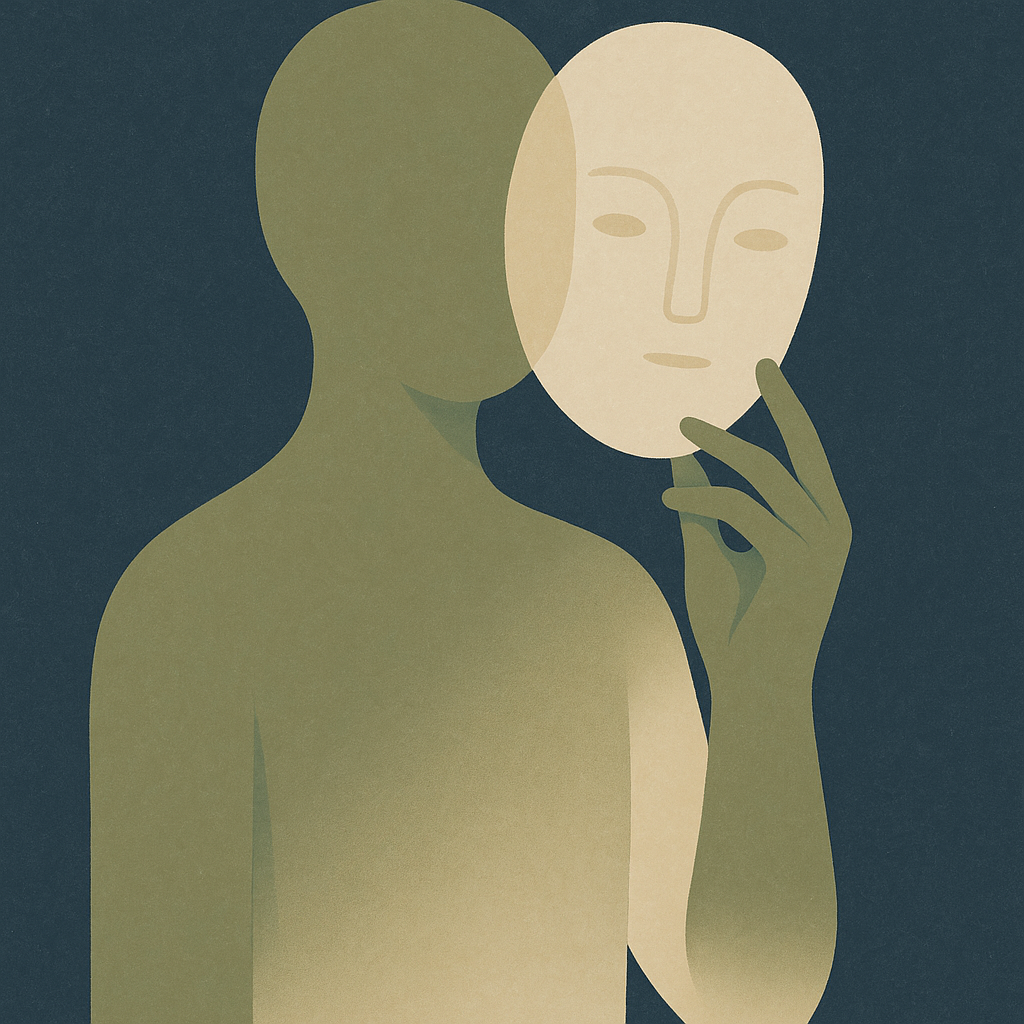
Masking (or camouflaging): the set of conscious or unconscious strategies a neurodivergent person uses to appear neurotypical in social contexts. Staying still when you want to move. Forcing eye contact. Rephrasing “in normal language” an idea you wanted to say spontaneously. Copying other people’s intonations. Hiding intense interests to avoid judgement.
The scientific literature was first built around autistic masking [1] [2] . The concept was extended to ADHD more recently [6] and holds a central place in the AuDHD experience [5] .
The three main components (Hull 2020)
Laura Hull, author of the CAT-Q (Camouflaging Autistic Traits Questionnaire), identifies three axes [2] :
1. Compensation
Actively seeking to fill in your gaps. Studying social rules. Memorising conversation scripts. Imitating a colleague who “knows how”. Learning emotions by observation, not by feeling them.
2. Masking (in the narrow sense)
Actively hiding visible traits. Suppressing stims (self-soothing motor automatisms). Blocking natural facial expressions. Containing a voice that wants to rise in volume. Not laughing too loud, not talking too fast.
3. Assimilation
Playing a character suited to the group. Laughing at jokes you don’t understand. Saying you liked the film. Agreeing to avoid conflict. Erasing your identity through mimicry.
I was putting on my best normal. I’d prepare what I was going to say on the way there. I’d mimic expressions I’d seen on TV. By the end of the evening, I was as exhausted as if I had run a marathon.
Why we do it
Masking is not a whim. It has rational functions in the short term:
- Avoiding stigma: stares, mockery, exclusion.
- Keeping your job: many professional environments do not tolerate visible neurodivergence.
- Preserving relationships: partners, friendships, families who lack the tools to understand.
- Surviving school: masking often starts very young, sometimes from kindergarten.
- Being “useful” socially, feeling included.
Many neurodivergent women describe starting to mask before age 10. It is not a conscious strategy — it is an automatic compensatory adaptation [4] .
The long-term cost
The literature documents a robust link between intense masking and deteriorated mental health [3] :
- Burnout: executive, emotional, sensory. In AuDHD people, “autistic burnout” is often the final path of sustained masking.
- Depression: strong correlation between high CAT-Q scores and depressive symptoms [3] .
- Social anxiety: masking feeds the fear (“what if I’m found out?”).
- Identity loss: from playing characters so long, you forget who you are when no one is watching.
- Late diagnosis: masking hides traits from clinicians themselves. Many women are diagnosed at 30–45 after decades of masking [5] .
Masking in women
Neurodivergent women mask more, and earlier, than men. The compounding reasons:
- Strong gendered social pressure from childhood (be nice, calm, sociable).
- Heightened sensitivity to social codes that are taught to them more intensely.
- Harsher social sanctions against “unfeminine” traits (hyperactivity, bluntness, technical interests).
- Diagnostic models historically built on male profiles — women have to mask to “fit” or remain undiagnosed.
Result: an ADHD or autism diagnosis in a woman often arrives between 30 and 45, typically triggered by:
- A child’s diagnosis.
- Severe burnout.
- Perimenopause (masking becomes biologically more costly).
- The end of a relationship that provided external structure.
Can you “stop” masking?
Nuanced question. Specialised practitioners [5] [6] agree on several points:
- Fully unmasking, everywhere, at once, is rarely possible or even desirable. Some professional and social contexts still require adaptation.
- Automatic masking is hard to switch off. Decoding it and selectively releasing it can take years.
- Finding “mask-off” spaces is crucial: inner circle, neurodivergent communities, a trained therapist.
- Unmasking means (re)discovering your identity: who you are when you aren’t performing. Sometimes a destabilising process.
- Total unmasking in a relationship or family requires the people around you to be ready to welcome you socially “naked”, with your tics, interests, needs. That isn’t always the case.
Strategies for managing masking
Awareness
- Learn to spot when you’re masking (“hey, I just laughed at a joke I didn’t understand, I’m masking”).
- Recognise body signals: jaw tension, shoulders, voice rising, etc.
Recovery
- Mandatory solo time after any masking-intensive event (long meeting, party, interview).
- Decompression protocols: 30 min silence + free movement + stims allowed.
- See: Post-masking decompression protocol (coming).
Selection
- Choose contexts where you can mask less: neurodivergent friends, online communities, specialised therapist.
- Tell a close person “I don’t mask with you — that means I can move, stay quiet, leave if I need to”.
Long term
- Neurodivergent-aware psychotherapy to explore what was hidden.
- Official diagnosis that legitimises needs (accommodations, workplace adjustments).
- Community: feeling you’re not alone in this fatigue.
To remember
- Masking is scientifically documented (mostly for autism, emerging for ADHD).
- It has rational short-term functions and a massive long-term cost.
- Women and AuDHD adults statistically mask more.
- It is associated with burnout, depression, anxiety, identity confusion, late diagnosis.
- Selectively unmasking in safe spaces is more realistic than “stopping masking”.
Going deeper
- AuDHD burnout — recognising the signs
- AuDHD — when ADHD and autism coexist
- Alexithymia — when the feelings are there but the words are not
- CAT-Q test (English): embrace-autism.com/cat-q/ (external link)
Sources citées
Chaque source est classée par niveau de preuve. Clique pour lire l'original.
- [1]Clinique2017'Putting on My Best Normal': Social Camouflaging in Adults with Autism Spectrum Conditions — Hull L, Petrides KV, Allison C, et al.
Founding qualitative study on autistic masking.
↑ retour au texte - [2]Clinique2020Development and Validation of the Camouflaging Autistic Traits Questionnaire (CAT-Q) — Hull L, Mandy W, Lai MC, et al.↑ retour au texte
- [3]Clinique2018Experiences of Autism Acceptance and Mental Health in Autistic Adults — Cage E, Di Monaco J, Newell V
Link between masking and deteriorated mental health.
↑ retour au texte - [4]Clinique2019Good social skills despite poor theory of mind: exploring compensation in autism spectrum disorder — Livingston LA, Happé F↑ retour au texte
- [5]Praticien2024Autistic Masking and Camouflaging — Dr. Megan Anna Neff, Neurodivergent Insights↑ retour au texte
- [6]Praticien2023ADHD Masking and the Exhaustion of Hiding Your Brain — ADDitude Magazine↑ retour au texte