Time blindness — when the ADHD brain only has two times: now, or never
Time blindness describes the altered perception of time typical of ADHD: trouble estimating durations, sensing the future, preparing for deadlines. This is not negligence.
The concept
“I know I have to leave in 15 minutes. I know. But I can’t feel those 15 minutes passing.”
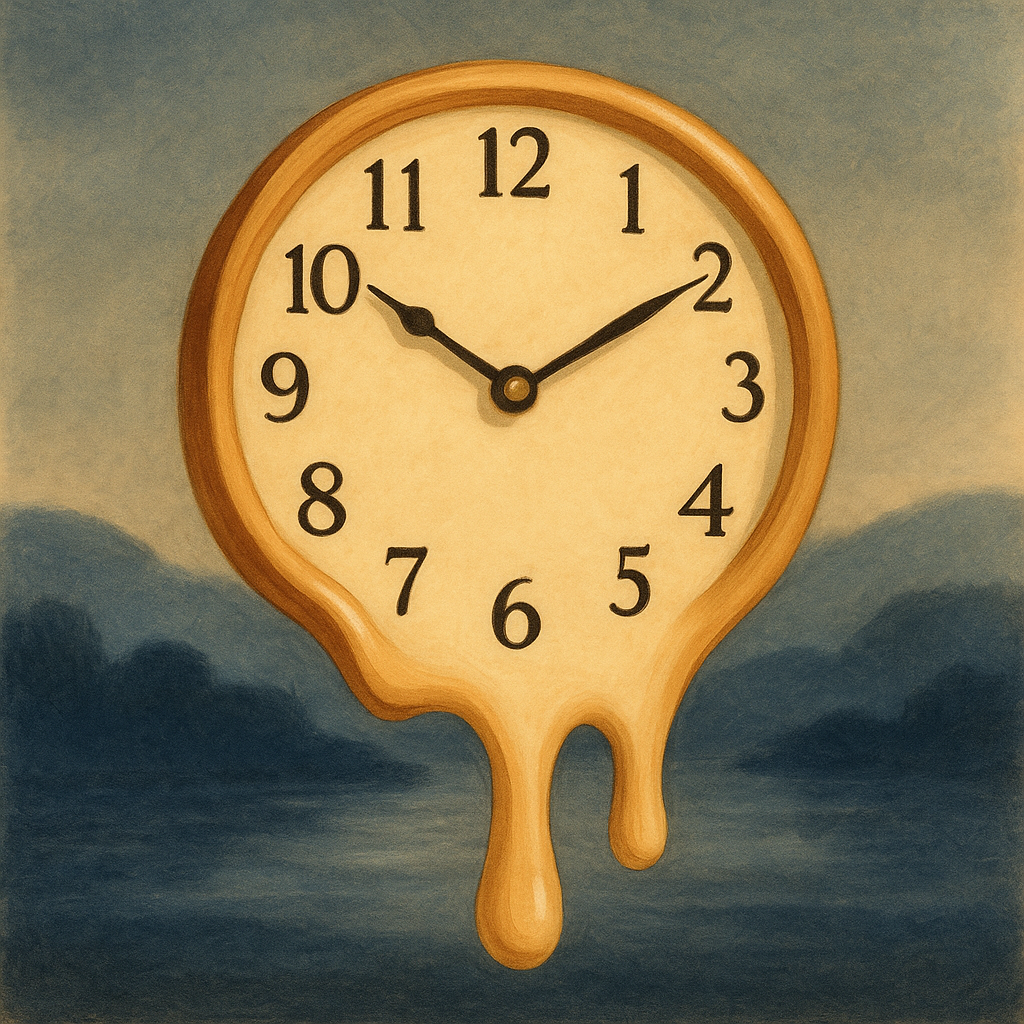
Time blindness describes exactly that: knowing the time intellectually, without sensing it. Having no inner compass that says “right, start getting ready now”. Time exists as an abstract concept — not as lived flow.
Russell Barkley [1] placed this phenomenon at the heart of his ADHD theory as early as 1997: ADHD, he argued, is fundamentally a disorder of executive temporal function. Attention is not deficient “in general” — it is deficient in its ability to project into time, to keep a future goal present to mind.
The ADHD brain’s only two times
Barkley offers a now-famous formulation: for the ADHD brain, there is “now” and “not now” [2] .
- “Now”: what is in front of me right now. Absolute priority, immediate emotion, action possible.
- “Not now”: everything else. Friday’s meeting, the tax bill in 3 months, Monday’s appointment. All of it is blurry, distant, undifferentiated.
The problem: “not now” also includes “in 15 minutes”. The brain does not finely distinguish between “in 15 min” and “in 3 months”: both are “not now”.
The day before a deadline, it doesn’t exist for me. I’m not avoiding it — I simply can’t feel it. Then at midnight the deadline becomes “now” and my brain flips on. I deliver the next morning, in a panic, but I deliver.
Concrete manifestations
Per the literature [3] [4] [5] :
- Systematic underestimation of durations: “5 minutes” for a task that actually takes 30.
- Chronic lateness despite sincere wishes to be on time.
- Massive procrastination on distant deadlines, then panic-sprint the night before.
- “Time disappeared”: after a hyperfocus session, being unable to estimate how much time has passed.
- Trouble sequencing: three steps that need to happen in order, with no clear temporal visualisation.
- Feeling that “Monday” is as far away as “next month”.
What the science measures
Experimental studies [3] [4] confirm:
- Children and adults with ADHD significantly underestimate short durations (2–30 seconds).
- They overestimate very long intervals (minutes to hours).
- Temporal discrimination (telling 4 s from 5 s) is less precise.
- These gaps are more pronounced under cognitive load (multitasking, distraction).
Stimulant treatments partially improve temporal precision [4] . They do not fully correct it.
Compensatory strategies
Clinical work [2] [5] converges on one central idea:
Externalise time. Do not rely on the internal clock.
Make time visible
- Time Timer or visual analogue timer: physically watch the time shrink.
- Clocks everywhere, big, with mechanical hands (more intuitive than digital).
- Digital hourglass or app that shows time remaining as a coloured bar.
Anchor time to physical reminders
- Leave an object that recalls the deadline (file on the desk = “due Tuesday”).
- Write the deadline in RED on the calendar, not in a buried Google Doc.
- Visible photo as trigger (“photo of the file on your fridge”).
Plan “for tomorrow”, explicitly
- The night before: write 3 tasks for tomorrow, with estimated duration × 1.5.
- Morning: read that list before any other screen.
- Accept that more than 3 tasks a day is too many.
Temporal rituals
- Same time = same activity. The ADHD brain latches onto environmental patterns better than intentions.
- 7am coffee → 8am shower → 9am work, no decision in between.
Body doubling and time partners
- Working alongside someone else reintroduces an external rhythm.
Body alarms
- Alarms for drinking, eating, urinating, leaving the screen.
- Not just task alarms: need alarms.
Special cases
Students
Short deadlines (due tomorrow) activate; distant ones (thesis in 3 months) vanish. Solution: break a big project into 12 small nearby deadlines.
Parents with ADHD
Getting a child ready in the morning is a temporal nightmare: 8 micro-steps, each fragile. Visually pre-loaded routines (pictogram lists) + in-between timers.
Long-deliverable jobs
If the brain only senses “now”, turn month-by-month projects into week-by-week sprints. Team structure or external discipline needed.
What does NOT work (and why)
- “Keep a to-do list”: a to-do list has no temporality. It is the quiet enemy of ADHD.
- “Set phone reminders”: notifications become background noise; you swipe them off reflexively.
- “Breathe and be present”: the issue is not anxiety — it is temporal structure. Meditation does not address time blindness.
To remember
- Time blindness is a documented neurocognitive phenomenon, not a personality trait.
- The ADHD brain perceives mainly “now” vs “not now”.
- The key strategy: externalise time via objects, calendars, partners, routines.
- Stimulant treatments help, but do not erase the phenomenon.
- Self-blame only slows things down: the work is to build an environment that compensates.
Going deeper
Sources citées
Chaque source est classée par niveau de preuve. Clique pour lire l'original.
- [1]Clinique1997Behavioral inhibition, sustained attention, and executive functions: Constructing a unifying theory of ADHD — Barkley RA
Founding article of the Barkley model on ADHD and time perception.
↑ retour au texte - [2]Praticien2022Taking Charge of Adult ADHD — Russell A. Barkley↑ retour au texte
- [3]Clinique2017Time estimation in children with ADHD — Walg M, et al.↑ retour au texte
- [4]Clinique2020Time Perception and Duration Judgments in ADHD — Nielsen TM, Mette C
Meta-analysis on adult ADHD time perception.
↑ retour au texte - [5]Praticien2023Time Blindness: Why People with ADHD See Time as Now and Not Now — ADDitude Magazine↑ retour au texte